Our Research
Investigating the mathematical foundations that make systems smarter, safer, and human-aligned.
Research Pillars
Our Research activities are centred around the following five pillars:
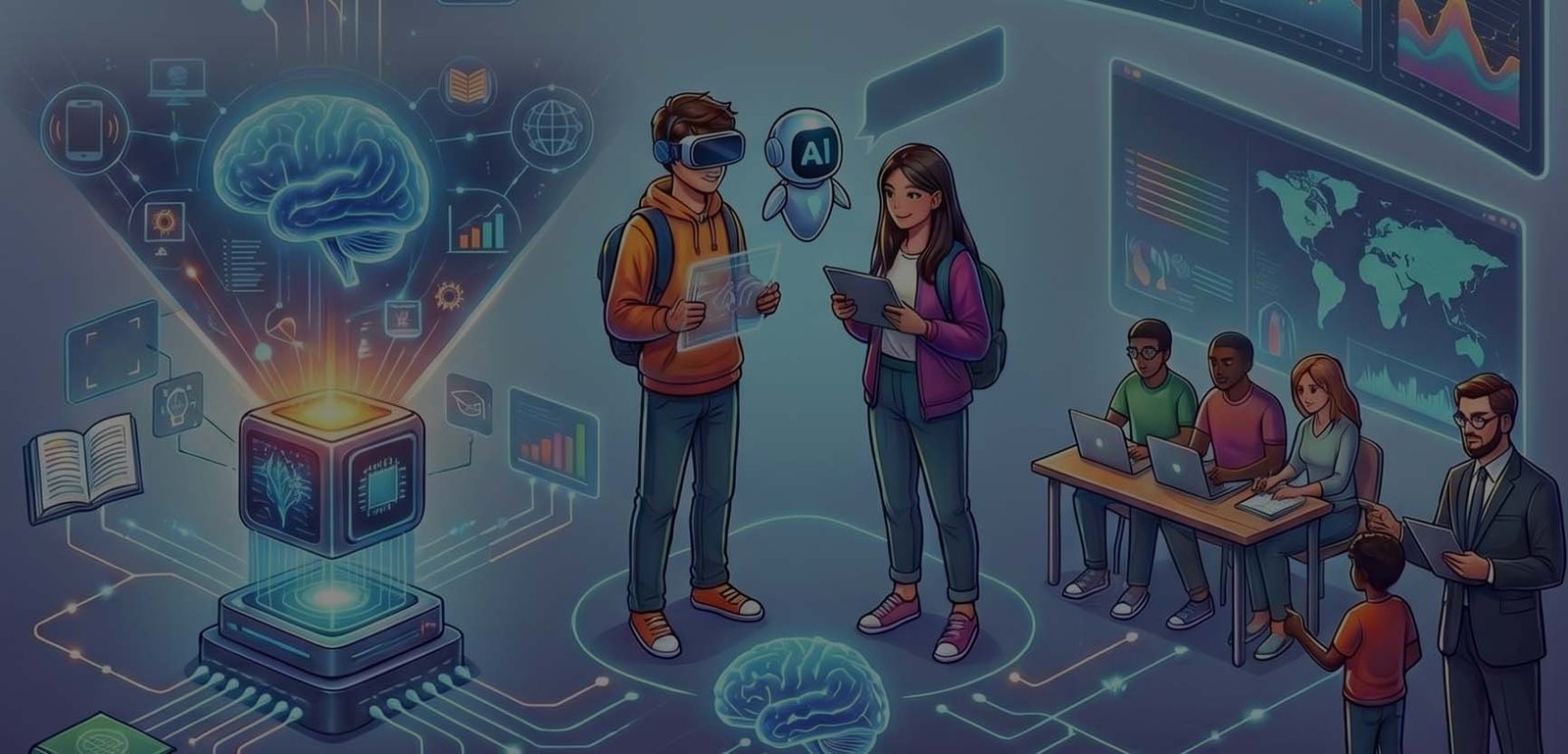
AI in Education
Revolutionizing the Landscape of Learning
Education is at a transformative crossroads. Our foundation is committed to exploring how Artificial Intelligence can dismantle traditional barriers to learning, moving beyond standardized "one-size-fits-all" models toward a future of personalized, accessible, and high-impact pedagogy. We focus on fundamental research into intelligent systems that don't just deliver content, but understand the learner.
"True innovation in education occurs when technology recedes into the background, leaving behind a seamless, intuitive experience that fosters a lifelong passion for discovery."
Key Areas of Investigation
- Intelligent Tutoring Systems (ITS): Developing AI-based tutors capable of providing nuanced feedback and step-by-step guidance. Unlike static videos, these systems simulate a human-like dialogue, identifying specific misconceptions and offering targeted interventions.
- Cognitive Load Optimization: Using AI to measure and respond to a learner's mental effort. By optimizing how information is presented, we can maximize retention and prevent burnout.
- Automated Assessment & Insight: Building tools that go beyond multiple-choice grading. We are researching NLP models that can evaluate complex essays and creative projects, providing immediate, constructive critique.
Our Vision for the Future
The goal of our research is to empower both students and educators. We believe AI should serve as a powerful catalyst for "Ease of Providing Education," reducing the administrative and regulatory burdens on institutions while amplifying the creative potential of teachers.
- Bridging the Equity Gap: Providing high-quality, AI-driven educational support to remote or underserved communities.
- Lifelong Learning Narratives: Creating AI systems that evolve with the individual, maintaining a continuous record of growth and mastery.
- Human-Centric AI: Ensuring technology remains a tool for human connection. By automating routine tasks, AI frees educators to focus on mentorship.
Reinforcement Learning
The Science of Adaptive Decision-Making
At its core, Reinforcement Learning (RL) is the computational study of how agents can learn to make optimal decisions through trial and error. Unlike supervised learning, which relies on a fixed "answer key," RL focuses on interaction. Our foundation explores the mathematical frameworks that allow systems to navigate complex environments, learn from consequences, and evolve.
"Reinforcement Learning is about more than just software—it is about the fundamental logic of agency. We are building the frameworks that allow machines to learn from the world, rather than just from our data."
Core Research Pillars
- Exploration vs. Exploitation Trade-offs: Refining algorithms that determine when an agent should try something new versus when it should stick to what it knows works.
- Offline and Safe RL: Developing methods that allow agents to learn from historical data without needing dangerous real-world experimentation. We prioritize "Safety-First" frameworks.
- Reward Function Engineering: Researching how to define complex goals in mathematical terms to avoid "reward hacking" and align with human outcomes.
Real-World Impact
- Autonomous Infrastructure: Managing power grids, optimizing supply chains, and navigating transit systems in real-time.
- Scientific Experimentation: Using RL to guide robotic lab assistants in discovering new materials by intelligently choosing experiments.
- Adaptive Resource Allocation: Building systems to dynamically shift resources during crises or high-demand periods.
AI for Optimization & Algorithms
Powering the Next Frontier of Discovery
At the heart of the modern digital revolution lies a fundamental challenge: how do we find the most efficient path through an ocean of data and complexity? Our foundation is dedicated to the fundamental research of advanced computational methods that bridge the gap between theoretical mathematics and real-world breakthroughs.
“Our goal is not just to build faster machines, but to design smarter ways for machines to think—turning complex obstacles into elegant, algorithmic solutions.”
Our Research Focus
We explore the intersection of Machine Learning and Mathematical Optimization, focusing on three core pillars:
- Neural Combinatorial Optimization: Using deep learning—specifically Reinforcement Learning and Graph Neural Networks—to solve complex combinatorial problems like vehicle routing and circuit design.
- Stochastic & Large-Scale Optimization: Developing robust algorithms that can operate under uncertainty and scale to massive datasets.
- Physics-Informed Algorithms: Integrating physical laws directly into the learning process to ensure solutions are mathematically optimal and physically viable.
Why It Matters
Fundamental research in optimization is the "silent engine" behind global progress. Our work aims to:
- Enhance Resource Efficiency: Minimizing waste in logistics and manufacturing through superior algorithmic precision.
- Democratize Advanced Computing: Creating lighter, faster algorithms that allow sophisticated AI to run on accessible hardware.
Autonomous Systems
Engineering Independent & Ethical Intelligence
The frontier of modern robotics lies in Autonomy—the ability of a system to perceive its environment, reason about its state, and take action to achieve goals without continuous human intervention. Rather than simple automation, our work centers on dynamic agency: creating systems that can adapt when the "script" no longer fits reality, guided by a rigorous ethical compass.
"A truly intelligent system is one that knows the limits of its own intelligence. Our mission is to build autonomy that is not only 'smart' but also 'wise' enough to operate safely and accountably within a human-centric world."
Key Research Frontiers
- Robust Perception & Sensor Fusion: Integrating disparate data streams (LiDAR, vision) to build high-fidelity understanding in "noisy" environments.
- Path Planning & Navigation: Investigating algorithms that allow agents to navigate safely through crowded, changing spaces.
- Edge Intelligence: Optimizing decision-making models to run directly on local hardware for split-second responses.
The Safety-by-Design Mandate
As autonomous agents transition to the real world, performance must be matched by verifiable safety and ethical alignment. We integrate these guardrails directly:
- Formal Verification: Employing mathematical proofs to guarantee an agent will never enter a "prohibited state."
- Explainable AI (XAI): Researching "interpretable" architectures that allow an agent to provide a human-readable rationale for its actions.
- Fail-Operational Protocols & HITL Ethics: Developing "safe modes" and investigating "sliding autonomy" where a system proactively hands control back to a human.
Scientific Machine Learning
Accelerating the Speed of Discovery
Scientific Machine Learning (SciML) represents a powerful new paradigm at the intersection of traditional scientific modelling and modern Artificial Intelligence. While conventional AI often acts as a "black box," our foundation focuses on SciML to create transparent, physics-aligned models that respect the fundamental laws of nature.
"Science has always been about finding patterns in the chaos. Scientific Machine Learning provides us with the ultimate lens to see those patterns clearly, turning centuries of observation into days of insight."
Our Core Research Areas
- Neural Operators & Multiscale Modelling: Developing operators to simulate complex systems like turbulent fluid flow thousands of times faster than traditional solvers.
- Automated Symbolic Regression: Using AI to "distil" raw experimental data into elegant mathematical formulas.
- Differentiable Programming for Science: Integrating machine learning directly into existing scientific software stacks for complex simulators.
Impact on Global Discovery
- Revolutionize Drug Discovery: Accelerating the simulation of molecular interactions.
- Optimize Sustainable Energy: Modelling plasma physics for fusion energy or designing next-gen battery materials.
- Predict Climate Dynamics: Creating high-fidelity, localized climate models for precision preparation.
- Advance Materials Science: Discovering novel "super-materials" by simulating atomic structures at scale.